The Hidden Costs in Your Supply Chain: 7 Operational and Transportation Expenses Most Companies Overlook
If running your supply chain has felt more demanding lately, you are not alone. Seven avoidable supply chain costs are hidden in plain sight. Addressing them can create the breathing room needed for meaningful growth.
A December 2024 report from BCG found that the top priority for global business leaders is cost management, with supply chain and manufacturing costs cited as very important by 65% of respondents. Many point to economic uncertainty, geopolitical tensions and technological disruptions as the major drivers behind the increasing importance of supply chain resilience.
In 2025, the focus on cost management has yet to loosen its grip, remaining an executive priority in a year characterized by a challenging economic environment. Despite the recognition of these needs, many organizations are still falling short of their savings goals. In June 2025, BCG reported that 48% of COOs reported that costs crept back up following previous reduction efforts, highlighting the difficulty of maintaining efficiency gains over time.
And while this period calls for sharper efficiency and smarter cost management, it’s harder to achieve when small inefficiencies, like tiny leaks in a ship, quietly drain performance where it matters the most.
In the context of day-to-day operations, we understand that leaders are focusing on keeping their operations afloat. It can be difficult to pinpoint exactly where inefficiencies lie, and it doesn’t help that the signs don’t always show up cleanly on a balance sheet.
That’s why today, we’ve outlined seven hidden costs in your supply chain. We’re bringing clarity to the hidden areas that can quietly erode efficiency, so you can operate with more confidence, stability, and control.

The 7 Operational and Transportation Expenses Overlooked by Most Companies
1. Inventory Misalignment and Hidden Holding Costs
One of the most common yet costly supply chain inefficiencies lies in inventory mismanagement. It’s no secret that excess inventory creates problems such as tying up capital, increases storage expenses, and drives up depreciation and obsolescence. At the same time, too little inventory leads to missed sales, lost opportunities, and strained customer relationships.
Most leaders recognize these risks, yet the true cost of imbalance often hides in day-to-day operations, buried in other factors such as carrying costs, expedited orders, and the constant effort to align supply with demand. Inventory misalignment often stems from a lack of accurate forecasting and real-time insights, with the problem further amplified by outdated inventory systems and processes.
To improve inventory management, we recommend implementing a real-time, end-to-end visibility system. Leveraging smart procurement strategies and a cloud-based SCM platform aligns purchasing with actual demand, which frees up capital and reduces waste. A system with integrated inventory optimization can provide real-time stock visibility, which allows for a dynamic redistribution of inventory in response to fluctuations in demand.
2. Process Gaps and Lack of Standardization
Every supply chain is made up of moving parts that need to work in rhythm to function well. When one part falls out of sync, the impact spreads quietly across operations. In many organizations, teams follow different processes for planning, purchasing, and reporting, each with their own tools, timing, and metrics to follow. This can create internal inconsistencies that create friction within an organization and increase costs through duplicate work, conflicting data, and slower decision making.
Process gaps and a lack of standardization are especially common after growth or acquisitions, when legacy workflows linger in different corners of the organization. This scenario played out in real-time when Avaya, a global communications company, operated as a worst-in-class supply chain after a series of rapid acquisitions. The merged organization had too many manual processes, redundant workflows, and multiple siloed IT systems. None provided a holistic view of the supply chain, and leaders needed a solution to tie the systems together.
Avaya decided to migrate all supply chain activities onto a cloud-based platform and launched a phased program to standardize processes, integrate data, and initiate a culture change of continuous improvement. They also transformed their supply chain by implementing a system of rigorous benchmarking and KPI tracking. The results were dramatic, and the changes lead to inventory turnover improving more than 200%, cash tied up in stock dropping 94%, and overall supply chain costs cut in half. This turnaround demonstrates how unifying systems and eliminating process gaps can unlock huge efficiency gains.
3. Hidden Waste and Overlooked Operational Costs
Not all inefficiencies are visible on a balance sheet, as demonstrated by hidden waste. Idle time and rework, excess handling or underused equipment, and lost productivity are all examples of non-value-added activities, increasing costs without providing value to the customer and draining resources across supply chains.
According to a 2024 analysis by manufacturing analytics firm Instrumental, 20% of every dollar spent in manufacturing is waste, adding up to $8 trillion in lost value. These include small inefficiencies, such as unnecessary steps, delayed handoffs, or idle equipment, that add up slowly and are difficult to detect in real time.
Hidden waste often stems from fragmented processes and disconnected teams. Resolving these issues begins with visibility: ensuring teams share the same data and can see issues as they emerge enables faster and more informed responses, reducing the amount of strain on operations.
4. Missed Cost-Reduction Opportunities
If hidden waste reflects the cost leaks present in operations today, missed cost-reduction opportunities explain why those leaks continue. These missed opportunities reflect the absence of a consistent, disciplined approach to monitoring costs over time. Without a clear system for reviewing recurring expenses and identifying problems early, small inefficiencies linger long after the initial fix, leaving teams to manage symptoms instead of resolving the root cause.
An IDC study found that companies lose a substantial amount of money each year to internal inefficiencies: an estimated 20-30% of revenue. In addition, a Gartner study found that while many companies implement cost-cutting initiatives, only 11% sustain those savings over three years, largely because the improvements rely on short-term cuts instead of long-term systems.
To truly sustain cost improvements, organizations have to shift from reactive cost-cutting to ongoing cost review processes. By establishing an ongoing cost management system, companies avoid the cycle of temporary savings that disappears and leaves operations exposed during periods of volatility, and instead will build the stability needed to withstand disruption.
5. 3PL Management and Costing Oversights
Many companies rely on third-party logistics providers to manage transportation, warehousing and fulfillment. While outsourcing can reduce overhead, costs aren’t always transparent, and factors like varying pricing structures and fees for storage, handling, peak surcharges and transportation can add up quickly if not actively monitored.
When companies treat 3PL costs as a fixed expense rather than one to actively manage, they end up overpaying. Small increases in handling rates, minimum charges, or transportation markups can accumulate, especially when shipping volumes fluctuate. These added costs get passed directly to shippers, adding to total logistics costs over time.
A 2025 survey from Inbound Logistics found that 72% of 3PL providers are struggling with rising operational costs. Because 3PLs pass operational cost increases directly to their consumers, many mid-sized companies experience higher logistics spending without realizing the root cause. With over 70% of 3PLs raising their rates each year, companies that examine these trends closely are in a better position to protect their margins. Understanding how and why 3PL costs shift is key to anticipating pressure points before they escalate into avoidable overspending.

6. Distribution Network Design Inefficiencies
A distribution network can appear to run smoothly while costing far more than it should. When customer demand shifts, transportation rates fluctuate, and product mixes shift, the network has to evolve as well, or hidden costs begin to accumulate.
When the network no longer reflects where customers actually are, companies end up shipping farther than necessary, duplicating inventory across sites, and relying on transportation routes not designed for current volumes. Research from Penske Logistics shows that approximately 80% of supply chain costs are related to network design decisions, highlighting how much an outdated structure can influence freight spend, lead times, and working capital.
The good news is that network design isn’t fixed, and can be reshaped to secure meaningful savings. Companies that take the time to re-evaluate their distribution setup often see a meaningful reduction in logistics costs simply by repositioning inventory, consolidating facilities, or adjusting fulfillment strategies.
7. Hidden Gaps in Freight Cost Optimization
Many mid-sized companies unknowingly lose money through hidden freight inefficiencies. Companies often assume transportation rates are fixed when they really shift based on volume, routing choices, contract structures, and market conditions. When freight isn’t actively managed, organizations end up paying more per shipment.
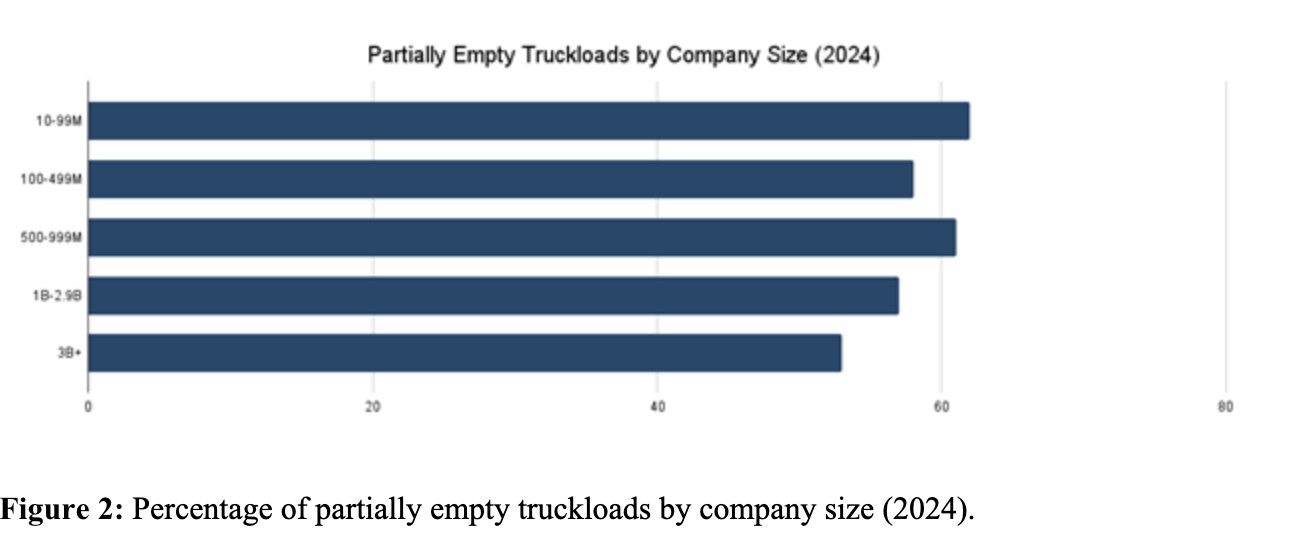
A recent Frock Freight and Drive Research study revealed that nearly half of all truckloads shipped partially empty, with the average capacity utilization sitting around 55%. This insight reveals that a substantial portion of paid-for space goes unused.
For mid-sized companies, the impact is clear when comparing utilization by revenue tier: firms between $100M-999M averaged 58-61% partially empty truckloads. This level of underutilization represents significant yet avoidable spending, and uncovers an opportunity to recapture costs through improved load planning, consolidation strategies, and smarter routing.
How Mitchell Taylor Helps
Supply chain inefficiencies are sneaky and don’t fix themselves. Most teams don’t have the time, internal resources, or visibility to find what’s driving hidden costs. That’s where Mitchell Taylor steps in.
We work alongside your team to identify the gaps that quietly impact performance, from inventory imbalance to transportation waste. Our approach combines data-driven analysis with practical, high impact adjustments that fit your scale and industry without using generic solutions or one-size-fits-all playbooks.
Whether your organization needs a fresh look at network design, better alignment across functions, or more control over freight spend, we provide the clarity and structure needed to turn insight into measurable results. Companies can operate with more confidence, stability and resilience, and can focus on growth rather than continuing to address the small leaks that wear away performance.
At Mitchell Taylor, we believe the right partner doesn’t just identify challenges, but helps you move forward with solutions that are achievable, sustainable, and grounded in real operational improvement.